
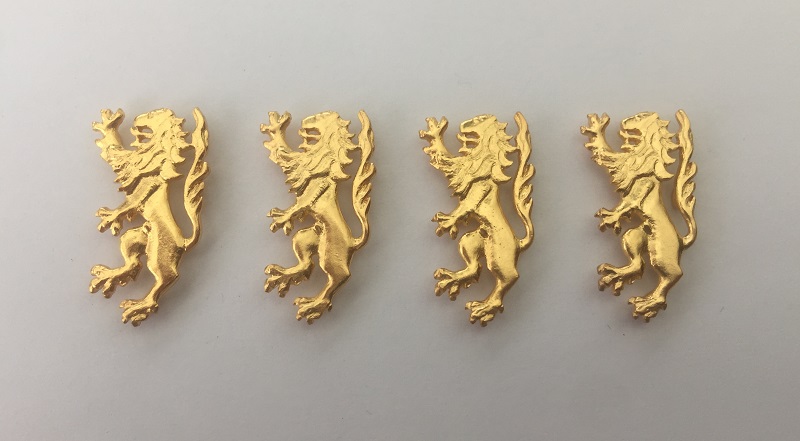
A manager from Berlin and - despite the distance - passionate lover of the Rhenish carnival commissioned us in late summer 2021 with the production of 50 gold-plated patches in the shape of a rearing lion for his remarkably elaborate “King Lionheart Coat”.
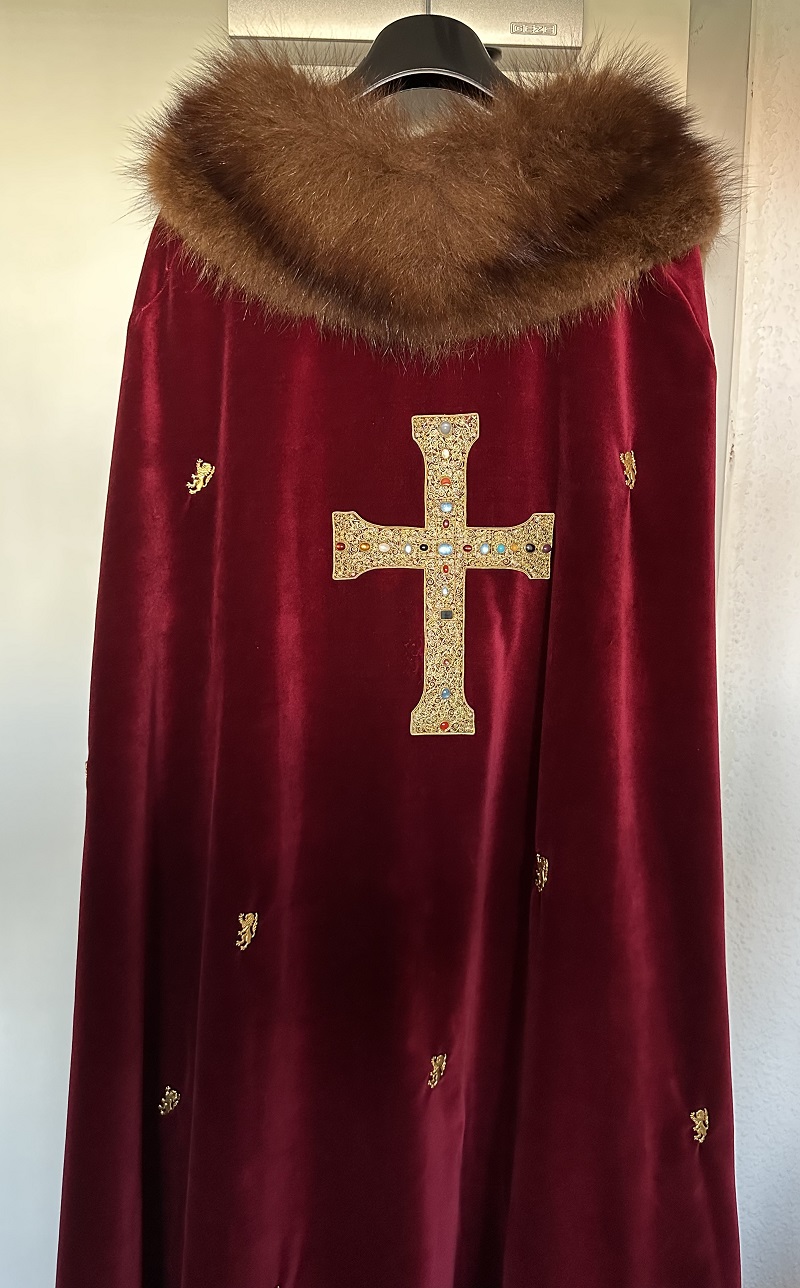
Our customer invested all his passion and not inconsiderable funds in an extraordinarily high-quality costume. He paid the utmost attention to every detail, no matter how small, so that in the end a true work of art was to be created: a velvet one tassel coat strewn with gilded lions, including a separate tabard that was to be sewn to measure for him by a tailor and additionally embellished with large and historically correct lion crests by a master embroidery maker; a decorated sword belt specially made by the saddler from the finest leather and elaborate coat clasps with the original seal of King Richard I ("Lionheart") - even the sword hilt was faithfully copied from the traditional model. Even the royal knight's helmet with integrated golden crown could not be missing.
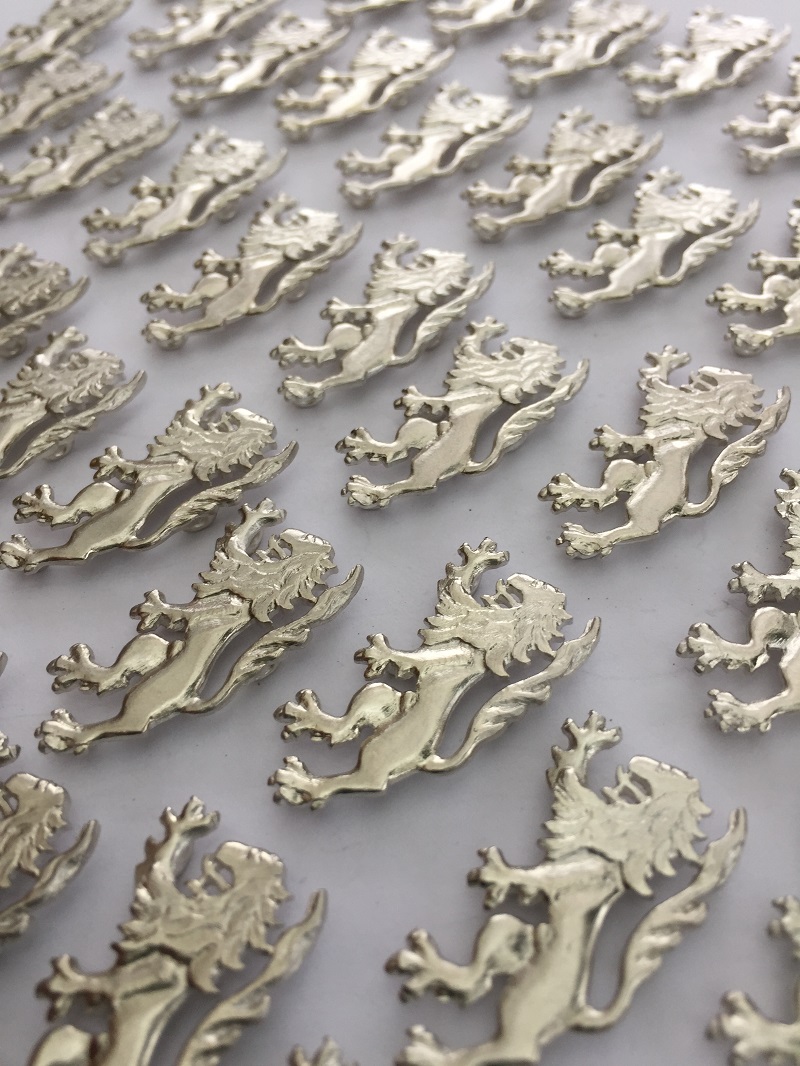
We were therefore very happy to be able to contribute the hand-crafted goldsmith objects to this truly unique costume. To do this, we first began by creating a prototype of a garment patch in the form of a genuine gold-plated "rising lion" made of 925 silver, which could be precisely coordinated with the customer in terms of appearance, all desired details and the future planned attachment to the tassel coat before its "mass production". To do this, we made various versions of the lion, which we sewed onto a small piece of fine cotton velvet so that the customer could get an accurate picture of the future effect of our lion patches on their coat.
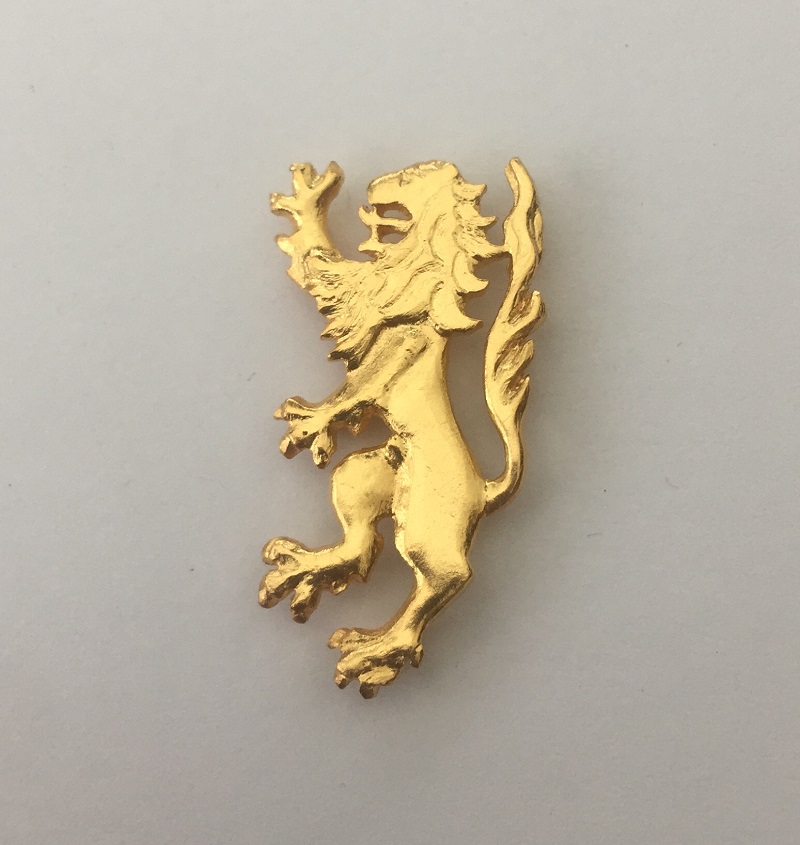
After the customer approved the prototype, we commissioned our precious metal supplier to create a detailed mold and then cast a total of fifty of these lions in fine sterling silver. These then had to be individually freed from their casting channels and cleaned up in our studio. At the end, all of the lion patches for the "King Lionheart Coat" were electroplated with fine gold.
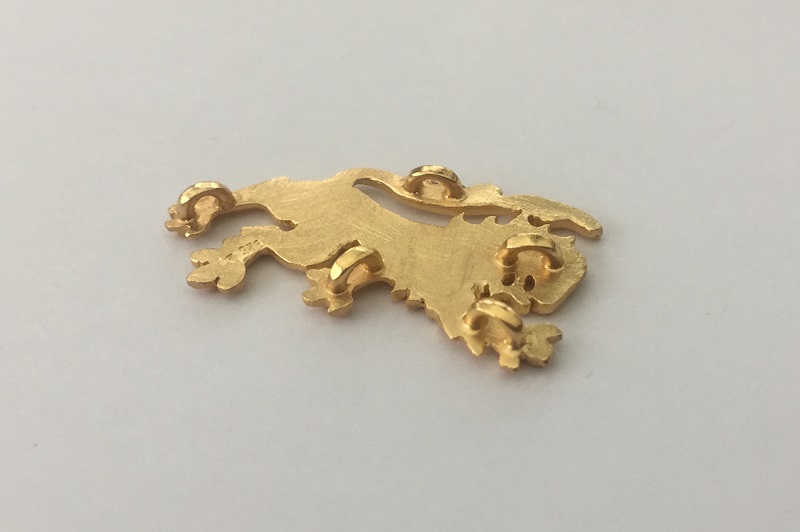
We are very excited to see how our lion patches, which are only 3 cm small but still fine, will later be able to visually enhance the already elegant tassel coat. This "King Lionheart costume" can probably hardly be surpassed and should therefore certainly not go unnoticed at the upcoming carnival events...
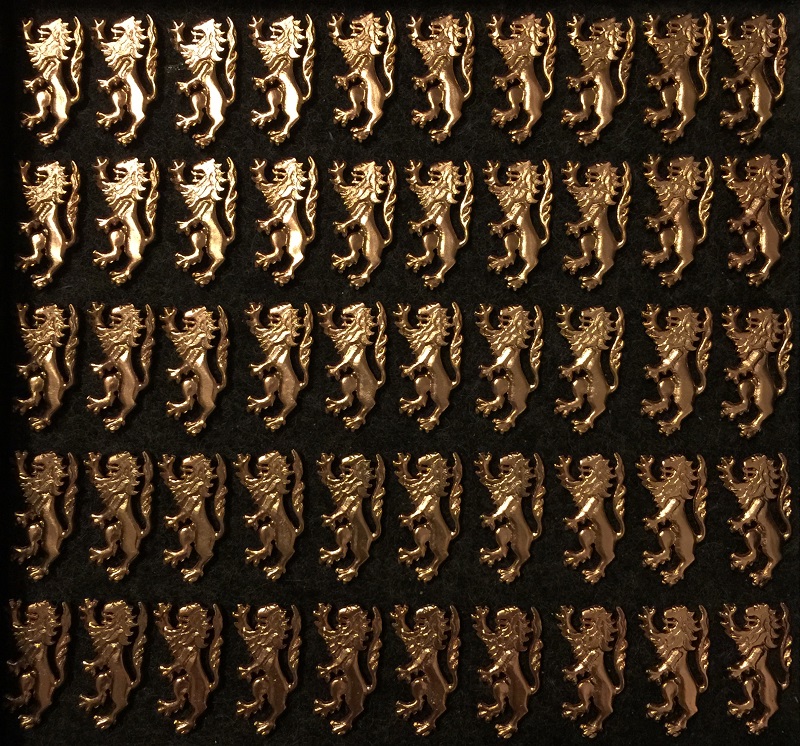
Gold plated lion heart patches ready to be shipped to the customer
In the end we were happy about the friendly feedback from our satisfied customer:
“… I am simply speechless with excitement at the sight of the 50-strong pride of lions… Fantastically beautiful! …
The lions look even more noble in real life than in the photos. Thank you very much for the great work! ...“
Update July 2023:
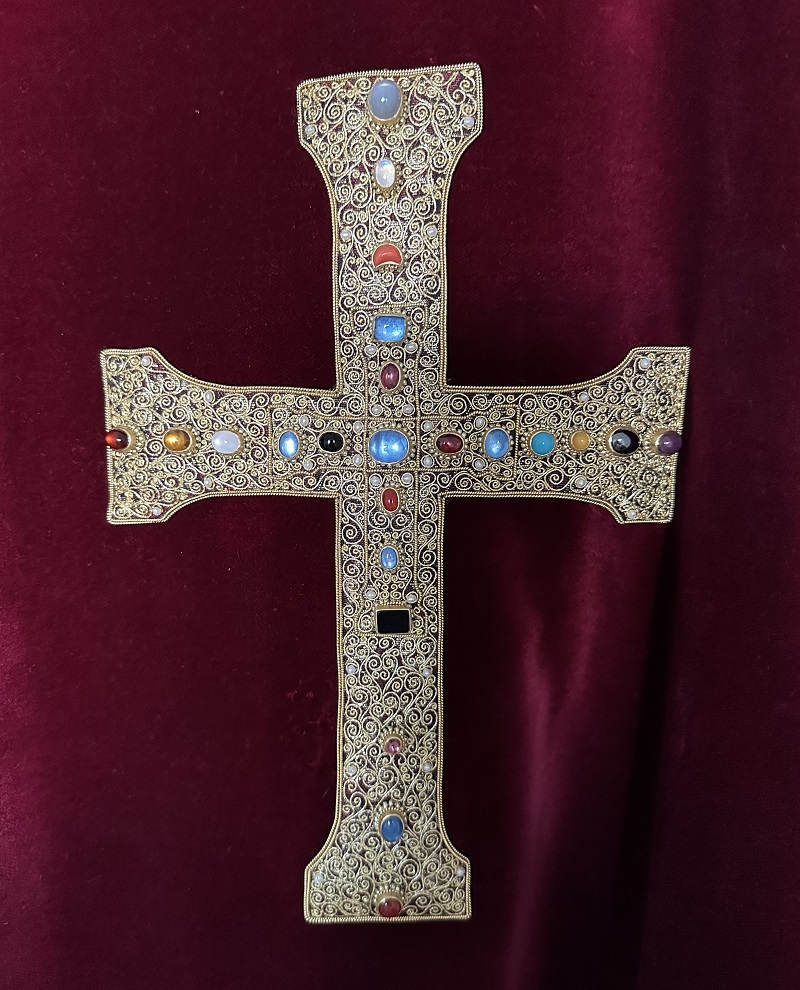
In the meantime, our customer has provided us with a video of the (almost) finished coat. The only thing missing now is the elaborately hand-embroidered "Reliquary Cross of Valasse" on the back of the coat. But even in this state, the extraordinary costume is already breathtaking:
Update December 2023 :
Our customer has kindly sent us the following photos of the finished tassel coat with the elaborately hand-embroidered “reliquary cross of Valasse” along with our gemstone settings and lion patches on it (Thank you very much for that!)
Interesting Facts about Richard the Lionheart
Richard the Lionheart, also known as Richard I of England, is one of the most famous and fascinating figures of the Middle Ages. Born on September 8, 1157 in Oxford, he became King of England, Duke of Normandy, Count of Anjou and Aquitaine, and leader of the Third Crusade. His nickname "Lionheart" symbolizes his courage, military brilliance, and reputation as one of the greatest knights of his time. But Richard's life was not only marked by glory and heroism, but also by political intrigue, territorial conflict, and personal challenges. This text sheds light on the life, reign, and legacy of a man who became a legendary figure in medieval history.
Childhood and youth
Richard was born the third son of Henry II, the first Plantagenet king of England, and Eleanor of Aquitaine. His father was one of the most powerful monarchs in Europe, while his mother was considered one of the most influential women of her time. Through Eleanor's inheritance, Richard was entitled to the Duchy of Aquitaine and the Countship of Poitou, which put him in a key position within the Anglo-Norman dynasty at an early age.
Despite his birth in England, Richard felt a stronger connection to French Aquitaine, where he spent much of his youth. From a young age he showed exceptional ability in the arts of war, politics and poetry. His mother, a shrewd strategist and patron of the arts, had a great influence on his upbringing and shaped his sense of chivalry and courtly culture.
rise to power
Richard's relationship with his father Henry II was marked by tensions. Together with his brothers Henry the Younger and Geoffrey, Richard repeatedly opposed his father's authority. These rebellions, which were supported by Eleanor among others, were part of a larger conflict over the distribution of power within the Plantagenet dynasty. Although Richard was defeated several times, he proved his military strength and assertiveness in these battles.
After the death of his elder brother Henry in 1183, Richard was designated heir to the crown. Nevertheless, relations with his father remained strained, particularly as Henry II attempted to limit Richard's power in Aquitaine. In 1189, Richard finally allied himself with the French king Philip II to depose his father. This conflict ended with Henry's death in July of that year, after which Richard ascended the throne and was crowned King of England in Westminster Abbey on 3 September 1189.
The Third Crusade
Richard's reign in England was marked by his commitment to the Third Crusade, which was declared after the fall of Jerusalem to Sultan Saladin in 1187. Driven by religious zeal and a desire for glory, Richard joined the international coalition that wanted to reconquer the Holy Land. Together with King Philip II of France and Emperor Frederick Barbarossa, he embarked on the crusade in 1190.
Richard's crusade is one of the most famous episodes of his life. After a difficult journey to the Holy Land, during which he conquered the island of Cyprus and married Berengaria of Navarre, Richard reached Acre in 1191, which he captured after a long siege. The victory at Acre was a great success, but it was accompanied by brutal measures, including the execution of around 2.700 Muslim prisoners - an act that is still controversial today.
In the following months, Richard led several successful military operations against Saladin's army, including the Battle of Arsuf, which cemented his reputation as a brilliant general. Despite these successes, he failed to recapture Jerusalem. In 1192, Richard concluded a truce with Saladin that guaranteed Christian pilgrims access to the holy sites without the city itself returning to Christian hands.
imprisonment and return
In 1192, on his way back to Europe, Richard fell into the hands of Leopold V, Duke of Austria, who captured him for personal and political reasons. Leopold handed Richard over to Emperor Henry VI, who released him for a huge ransom of 150.000 marks of silver - a sum that placed a heavy burden on England's population and led to a widespread tax collection. Richard's imprisonment was a humiliating experience, but it did little to diminish his popularity in England.
After his release in 1194, Richard returned to England, where he stayed only a short time to consolidate his rule. He then concentrated on his French possessions, which were threatened by conflicts with King Philip II. His final years were marked by military conflicts as he attempted to secure his control of Aquitaine and Normandy.
Death and Legacy
Richard's life ended abruptly on April 6, 1199, when he was struck by a crossbow bolt during a siege in the French province of Limousin. Although the wound did not initially appear fatal, an infection developed and Richard eventually succumbed to it. On his deathbed, he is said to have forgiven the archer who had wounded him - an act that befitted his reputation as an ideal knight. Richard was buried at Fontevraud Abbey alongside his father, Henry II, and his mother, Eleanor of Aquitaine.
Richard's death left a power vacuum that was filled by his younger brother John Lackland. While Richard's reign in England lasted only ten years, he spent most of his time abroad, making him known primarily as a warrior king rather than an administrative monarch.
Richard's legend
Richard the Lionheart became a legendary figure during his lifetime. His courage, military brilliance and commitment to the Crusades made him the epitome of the ideal medieval knight. He has often been heroized in English and French literature, for example in the novels about Robin Hood, in which he is portrayed as a just king fighting against the injustice of his brother John. However, this romanticized portrayal often obscures the political and moral ambivalences of his life.
Historians point out that Richard's reign was marked by high taxes, military adventures and a neglect of England's internal affairs. Nevertheless, he remains one of the most famous figures of the Middle Ages, whose life continues to fascinate today.
Richard's legacy lies not only in his military achievements, but also in his symbolic role as the embodiment of the ideal of chivalry. His nickname "Lionheart" is still a synonym for courage and bravery and secures him a firm place in European history and culture.
(This content was created with the help of artificial intelligence.)